


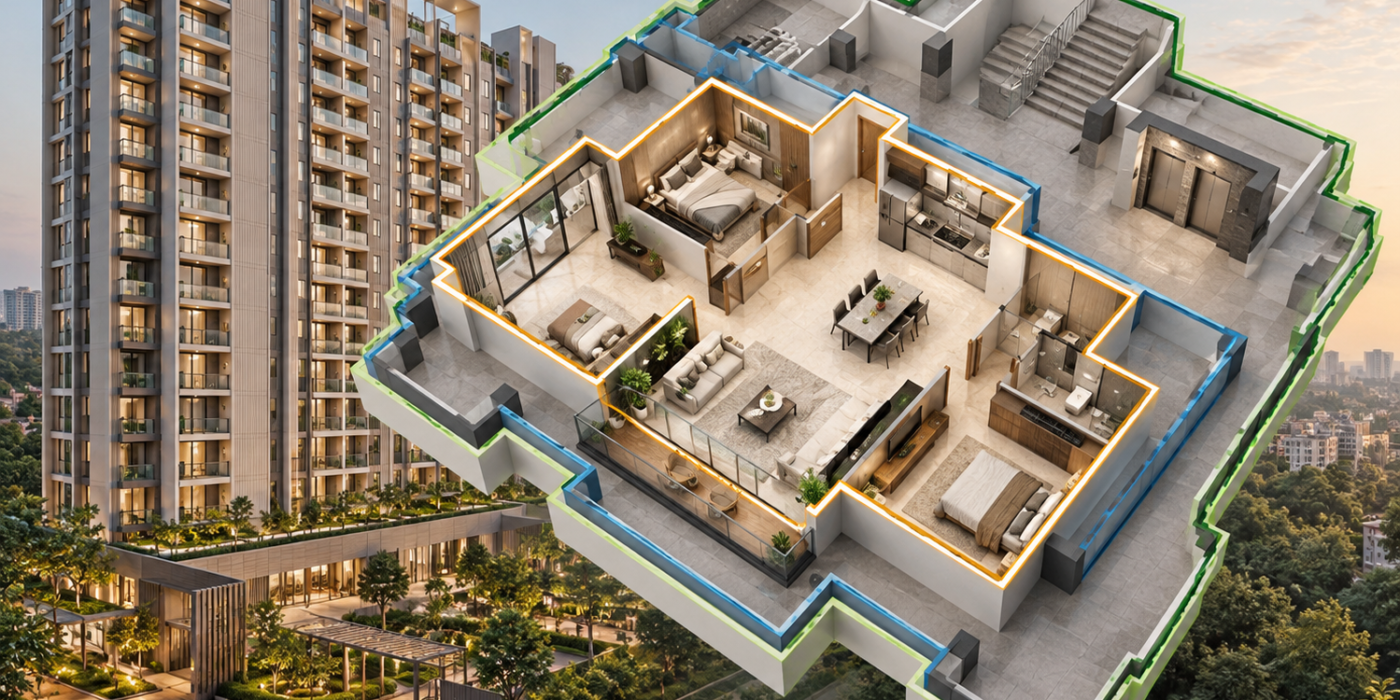
Carpet Area vs Built-Up Area vs Saleable Area: A Simple Guide for Homebuyers
Two flats are both advertised as “1,000 sq ft”. One feels noticeably bigger when you walk in. The difference is not the design. It is which area the number refers to.
Before you compare prices, you need to know three terms: carpet area, built-up area and saleable (super built-up) area. Here is what each one means and why it matters to your budget.
1. Carpet area: the space you actually use
RERA defines carpet area as the net usable floor area of a flat. It is the space where you can lay a carpet.
Included: all rooms, kitchen, bathrooms, and the thickness of internal walls.
Excluded: external walls, service shafts, exclusive balconies or verandahs, and exclusive open terraces.
This is the most honest measure of your home. Under RERA, developers must sell and price flats on carpet area. In Maharashtra, balconies, enclosed balconies and terraces are listed separately in the agreement, so you see exactly what you get.
2. Built-up area: carpet area plus walls
Built-up area = carpet area + external walls + balconies and terraces attached to your flat. It is usually 10–15% more than the carpet area. You own this space, but not all of it is usable for furniture or daily living.
3. Saleable or super built-up area: your share of common spaces
Saleable area = built-up area + your proportionate share of common areas such as the lobby, staircase, lift wells, corridors, and sometimes the clubhouse and amenities.
The extra area added over carpet area is called loading. In Pune it typically ranges from 25% to 40%, and can be higher in projects with large amenities.
A worked example
Say a flat is advertised at 1,000 sq ft super built-up area, priced at ₹7,000 per sq ft. Total price: 1,000 × ₹7,000 = ₹70 lakh. If the carpet area is 720 sq ft, your effective price on usable space: ₹70 lakh ÷ 720 = ₹9,722 per sq ft of carpet area.
The same flat can look cheap or expensive depending on which area the rate is quoted on. Always convert to carpet area before you compare.
Why this matters for homebuyers
Fair comparison: A lower rate on super built-up area can cost more per usable sq ft than a higher rate on carpet area.
Real living space: Carpet area tells you whether your furniture, study corner or second bedroom will actually fit.
Loan and resale: Banks and buyers increasingly look at carpet area when valuing a home.
Legal protection: Your Agreement for Sale records the carpet area. If the delivered area is smaller beyond the permitted limit (usually 3%), the developer must refund the difference with interest. Learn more about your RERA rights as a homebuyer.
5 smart checks before you sign
1. Ask for the RERA carpet area in writing for your specific unit.
2. Match it with the figure on the project’s MahaRERA page.
3. Check that balcony and terrace areas are listed separately, not added to carpet area.
4. Convert every quote to price per sq ft of carpet area before comparing projects.
5. Measure the flat at possession and compare with your agreement. Also factor in stamp duty and registration charges when calculating your total cost.
FAQs
Is balcony area included in carpet area? No. Under RERA, exclusive balconies and open terraces are not part of carpet area. In Maharashtra, they are shown separately in the agreement.
What is a good loading percentage? Around 25–35% is common in Pune. Higher loading is acceptable if it brings real amenities, but check the carpet area you receive.
Can a developer charge on super built-up area? No. For RERA-registered projects, the price must be based on carpet area.
Know what you are paying for
A home is measured in how you live in it, not just in square feet on a brochure. At Legacy Lifespaces, every unit is priced on RERA carpet area, with balcony and terrace areas shown separately. Plans are designed so that more of every square foot is usable. Explore our projects in Punawale, Rahatani, Wakad, Hinjewadi and Pimple Saudagar, or browse all our residential projects in Pune.